
Ne Zha II ends with Immortal Wuliang exposed as the architect of the false Chentang Pass story and the attempt to refine dragons and demons into immortality pills. Lady Yin dies inside the cauldron, and Ne Zha transforms grief into rebirth by absorbing its samadhi fire and stabilizing his restored body. Ne Zha, Ao Bing, the dragons and demons break the cauldron, forcing Wuliang to retreat. Ao Guang takes the surviving Dragon Clan into hiding, while Ao Bing stays with Ne Zha to expose Wuliang. A final prison scene leaves Shen Gongbao, Shen Zhengdao and Wuliang in place for the next conflict.
Ne Zha II ending: event, truth and consequence
The ending is easier to understand when the apparent event is separated from the later evidence and resulting character decision.
| Ending question | What is revealed | Immediate consequence | What remains unresolved |
|---|---|---|---|
| Who destroyed Chentang Pass? | Wuliang's operation attacks the city and frames the Dragon Clan | Ne Zha recognizes that his grief was weaponized | How the heavenly hierarchy will answer the exposure |
| Does Lady Yin survive? | No. She is refined inside the cauldron before Ne Zha can save her | Her death triggers grief and the samadhi-fire rebirth | How Ne Zha and Li Jing live with the loss |
| What happens to Ne Zha's body? | He absorbs the cauldron fire and stabilizes the reconstructed body | He can lead the breakout with restored strength | The long-term cost and development of that power |
| What happens to Ao Bing? | His body is restored and he fights beside Ne Zha | He chooses to remain and expose Wuliang | His future relationship with Ao Guang and the hidden clan |
| What happens to Ao Guang? | He survives and leads dragons and demons away from immediate capture | The clan returns to the seas and hides | Whether confinement, recognition and political status can change |
| Is Wuliang defeated? | He is exposed and forced to retreat, not permanently defeated | His authority is damaged but his network survives | The prison scene and the arrival of Jinzha and Muzha set up continuation |
People, places and objects resolved by the ending
Each relationship describes what the story establishes, without treating proximity as identity or romance.
Ne Zha哪吒
Demon Orb bearer and central heroHis choices turn feared power into protection and make assigned destiny the story's central argument.
PersonAo Bing敖丙
Dragon Prince and Spirit Pearl bearerFriendship with Ne Zha repeatedly conflicts with the survival duty imposed by his father and clan.
PersonLi Jing李靖
Ne Zha's father and Chentang Pass commanderFamily trust, public duty and sacrifice make him a structural part of every Chentang Pass crisis.
PersonLady Yin殷夫人
Ne Zha's mother and active defenderShe gives the family its most direct affection and pays the sequel's most devastating personal cost.
PersonTaiyi Zhenren太乙真人
Ne Zha's teacherHe trains Ne Zha, helps preserve the two souls and carries responsibility for restoring their bodies.
PersonAo Guang敖光
Dragon King and Ao Bing's fatherHe leads the Dragon Clan, carries its grievance and must decide whether his son's future belongs to the clan or to Ao Bing himself.
PersonShen Gongbao申公豹
Ao Bing's teacher and political strategistHis actions connect the stolen Spirit Pearl, Dragon Clan strategy and the later exposure of Wuliang's scheme.
PlaceChentang Pass陈塘关
Family home and defended cityThe same community that fears Ne Zha becomes the home he repeatedly chooses to protect.
OrganizationDragon Clan龙族
Confined political communityIts genuine grievance is exploited by adults who turn Ao Bing and Chentang Pass into instruments of a larger plan.
Story timeline
The heavenly lightning destroys both bodies
Ne Zha and Ao Bing survive only as souls. Taiyi spends the Sacred Lotus's power to reconstruct fragile physical forms.
Ao Bing shares Ne Zha's body during the immortal trials
The boys receive seven days to complete the trials and obtain medicine capable of restoring the Sacred Lotus and rebuilding Ao Bing.
Ne Zha is told Chentang Pass has been destroyed
The report directs his anger toward the dragons and makes him willing to assist the force gathering them into Wuliang's cauldron.
Li Jing, Lady Yin, Ao Bing and Taiyi reveal the framing
The family survived, and the evidence shows that Wuliang's side attacked the city and used the Dragon Clan as the official culprit.
Lady Yin dies as prisoners are refined
The cauldron converts captives into immortality pills. Lady Yin's death turns the political crime into an irreversible family loss.
Ne Zha absorbs the samadhi fire
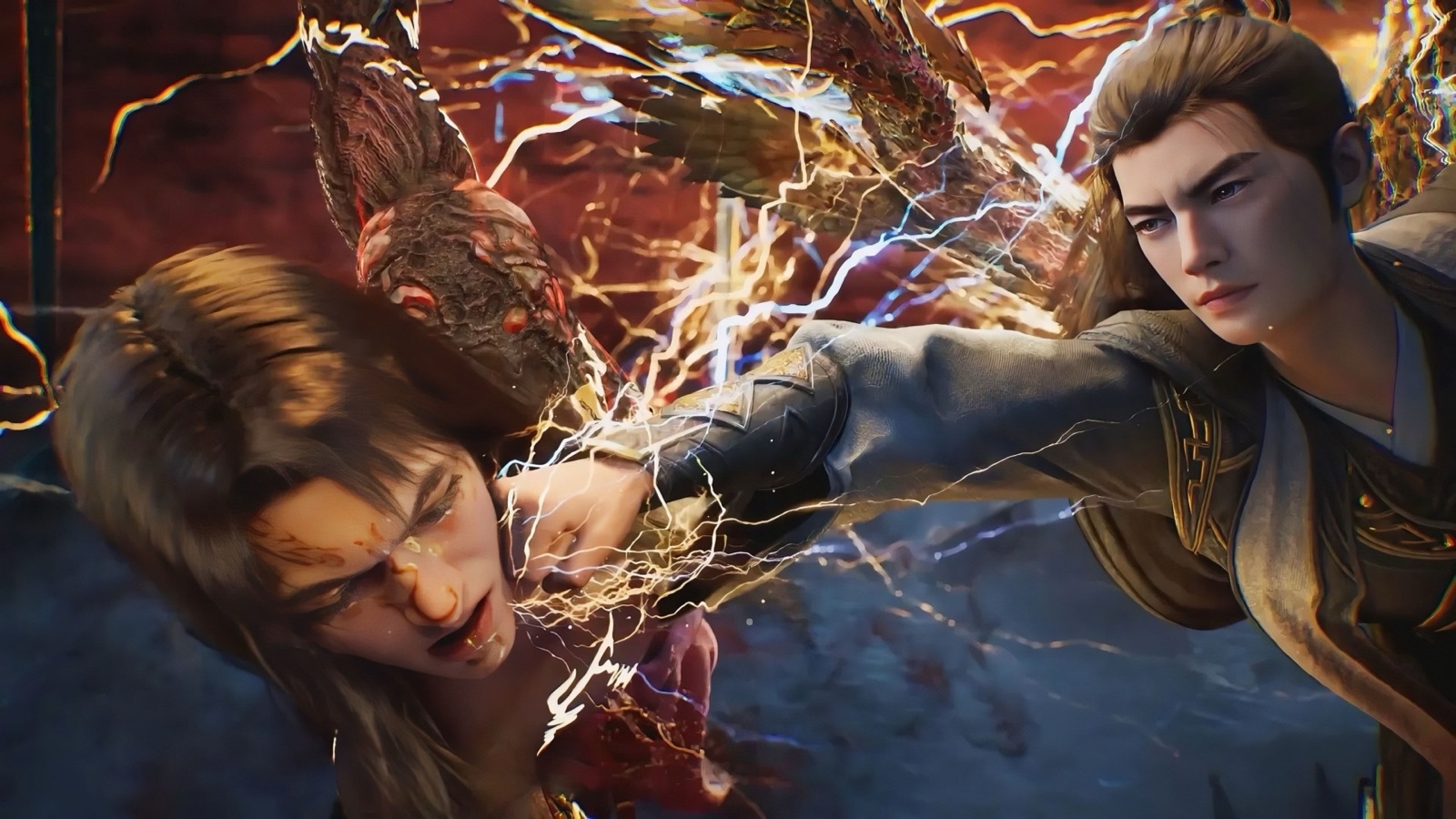
Instead of being consumed, Ne Zha uses the cauldron's fire to solidify his reconstructed body and returns with controlled strength.
Ne Zha, Ao Bing, dragons and demons destroy the cauldron
Formerly opposed groups cooperate against the institution attempting to turn them into resources, forcing Wuliang to retreat.
Ao Guang hides the clan while Ao Bing stays
Ao Guang leads survivors back toward the seas. Ao Bing remains with Ne Zha to help expose Wuliang rather than disappearing with the clan.
Why the ending begins with a false story
The final battle cannot be understood as only Ne Zha versus a stronger immortal. Wuliang first controls the explanation of what happened. Ne Zha is told that Chentang Pass has been destroyed and that the Dragon Clan is responsible. Because the city contains his parents, home and unresolved desire for acceptance, the report turns grief into immediate political obedience.
That manipulation is the ending's core mechanism. Wuliang does not need Ne Zha to become evil; he needs the hero to act before checking who benefits from the evidence. The Dragon Clan's earlier threat makes the accusation plausible, while the heavenly sect's official status makes its version appear trustworthy. The lie succeeds because it uses real history and real fear.
Li Jing and Lady Yin return as surviving witnesses
The arrival of Li Jing, Lady Yin, Ao Bing and Taiyi changes the battle by changing what Ne Zha knows. His parents survived the attack, and Shen Gongbao's defense of the city helps expose the direction from which the violence actually came. The scene restores Chentang Pass from an abstract casualty report to a place with witnesses and evidence.
Li Jing's role remains consistent with his identity as father and commander. Lady Yin's presence is equally important because it gives Ne Zha an immediate emotional reason to stop following the false narrative. Their survival briefly appears to reverse the tragedy, but Wuliang's cauldron soon creates a new loss that cannot be corrected by better information.

What Wuliang's cauldron is designed to do
The cauldron reveals how Wuliang's order views dragons and demons. They are not opponents to be defeated and released after judgment. They are raw material that can be refined into immortality pills. The process turns institutional prejudice into an economy: groups labeled dangerous become resources that strengthen the people controlling the label.
The betrayal by other Dragon Kings supports that system. Wuliang offers routes of individual escape while keeping collective capture intact. Ao Guang is isolated as the convenient culprit, the clan is divided and heavenly disciples can interpret the entire operation as legitimate purification. The cauldron is therefore weapon, prison and political argument at once.

Lady Yin's death and why it is not reversed
Lady Yin is caught in the refinement as the cauldron's heat transforms prisoners into pills. Ne Zha reaches the truth but not in time to save his mother. The death matters because the film does not allow every family loss to be repaired by the same body-restoration device that preserved Ne Zha and Ao Bing earlier.
Her loss also prevents the ending from becoming a cost-free victory over misinformation. Wuliang can retreat, but the consequences of his system remain inside the family. Li Jing loses his partner, Ne Zha loses the person who offered the most direct affection, and the audience understands that exposing an official lie does not restore everyone already harmed by it.
Ne Zha's samadhi-fire rebirth
Ne Zha responds first with grief, but the cauldron's fire does not simply amplify uncontrolled rage. He absorbs it and uses the pressure to solidify the body reconstructed by the Sacred Lotus. This is both a power event and a character event: the feared fire becomes something he directs rather than something that directs him.
The rebirth completes a pattern established across the two films. His body, title and spiritual origin can be assigned or destroyed from outside, but moral identity is built through repeated choices. The new stability does not mean that pain disappears. It means Lady Yin's death is carried into a deliberate resistance against the mechanism that killed her.

Why the dragons and demons fight beside Ne Zha
The breakout rearranges the apparent sides. Ne Zha began the final movement believing the dragons had destroyed his home. Once the lie is exposed, dragons, demons, Ne Zha and Ao Bing share an immediate enemy: the institution attempting to refine them while controlling the public account of why they deserve it.
Their cooperation does not erase every previous injury. Ao Guang's earlier decisions and the danger to Chentang Pass remain real. The alliance works because justice does not require pretending that all participants have always been innocent. It requires identifying the present crime accurately and refusing to let prior conflict justify extermination.
Ao Guang leaves and Ao Bing stays
After the cauldron breaks, Ao Guang leads the remaining dragons and demons into hiding in the seas. The withdrawal is not a triumphant political settlement. The clan still lacks security, and Wuliang's network still possesses institutional reach. Hiding preserves lives while postponing the question of recognition and freedom.
Ao Bing makes a different but compatible choice. He stays with Ne Zha to help expose Wuliang. The decision confirms that he is no longer only the instrument of his father's plan. He can serve the Dragon Clan by pursuing truth outside it, while keeping the friendship that allowed him to imagine an identity beyond inherited duty.
The prison scene and the next conflict
The final prison sequence shows that Wuliang's defeat is incomplete. Shen Gongbao and Shen Zhengdao remain valuable because they possess knowledge, family connections and grievances that can be recruited or suppressed. Deero and Crana remain part of the damaged enforcement network, and the scene retains the film's comic tone without removing the danger.
Jinzha and Muzha are summoned but do not find Wuliang as expected. Their arrival expands Ne Zha's family into the heavenly system and creates a natural path for the next story. The sequel therefore closes the cauldron battle while leaving three questions open: whether Wuliang can preserve authority, whether the Dragon Clan can return openly and how Ne Zha's older brothers will respond to the truth.
What the ending means
The simplest interpretation is that destiny is no longer the only false category Ne Zha must defeat. In the first film, people judge him through the Demon Orb. In the sequel, an institution judges entire communities through records, trials and official explanations. Personal prejudice has developed into a system capable of manufacturing evidence and profit.
Ne Zha wins by combining power with corrected understanding. Ao Bing wins by choosing friendship without abandoning concern for his clan. Ao Guang survives without receiving political resolution. Lady Yin's death prevents easy closure. The ending is hopeful because resistance becomes collective, not because every wound is repaired.
The conclusion also changes the meaning of immortality. Wuliang treats immortality pills, examinations and heavenly rank as proof of a superior order, yet those benefits are produced through hidden bodies and controlled records. Ne Zha's rebirth follows the opposite logic: he gains a more stable form by resisting the refining system and accepting the truth of a mortal relationship he cannot recover. The film asks whether living longer has value when the process requires other lives to become invisible material.
Sources used for this guide
The licensed North American distributor page anchors the first film and the relationships, assigned destinies and Chentang Pass conflict continued by Ne Zha II.
Ne ZhaWell Go USA Entertainment · Official North American first-film pageA24 confirms the licensed international title, 2025 film, director Jiao Zi, principal English cast and the sequel's official global premise.
Ne Zha IIA24 · Official international film pageNe Zha FAQ
What happens at the end of Ne Zha 2?
Ne Zha and Ao Bing help dragons and demons break Wuliang's cauldron after his conspiracy is exposed. Wuliang retreats, Ao Guang hides the surviving clan and Ao Bing stays with Ne Zha.
Does Lady Yin die in Ne Zha 2?
Yes. Lady Yin is transformed inside the cauldron during Wuliang's attempt to refine prisoners into immortality pills.
Who really destroyed Chentang Pass?
The ending reveals that Wuliang's operation ordered the attack and framed the dragons so Ne Zha and the heavenly forces would act against them.
How does Ne Zha survive the cauldron?
He absorbs and masters the cauldron's samadhi fire, using it to stabilize and strengthen the body reconstructed through the Sacred Lotus.
Is Wuliang dead at the end?
No. He is exposed and forced to retreat. The later prison sequence shows that he remains active and is trying to manage the consequences of the battle.
Does Ne Zha 2 set up another sequel?
Yes. Ao Bing remains with Ne Zha, Ao Guang and the clan go into hiding, Wuliang is still active, Shen Gongbao and Shen Zhengdao remain connected to the prison plot, and Jinzha and Muzha are summoned into the unresolved conflict.

What visual detail from Ne Zha should this guide explain next?