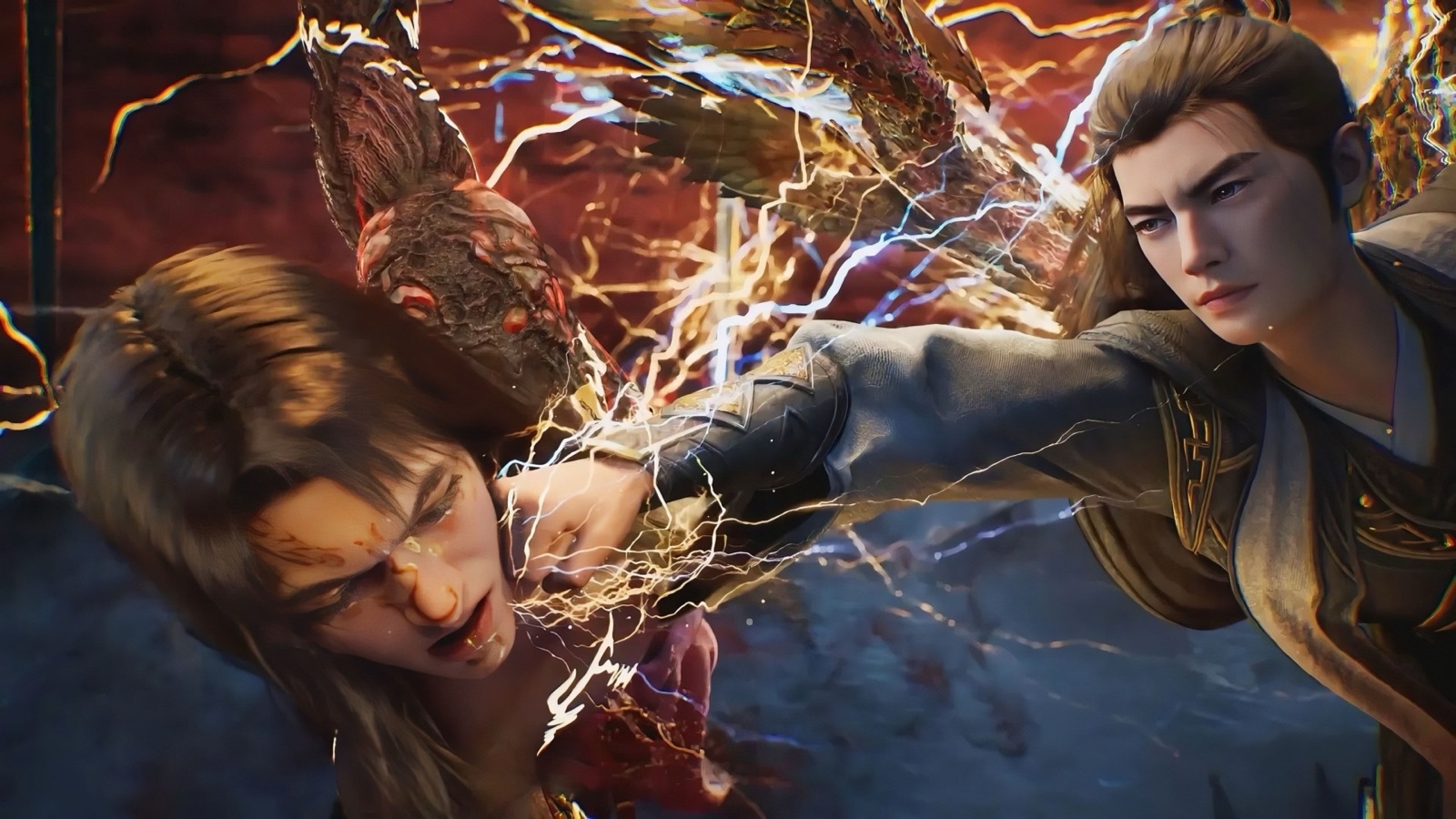
An ordinary child, not a chosen prodigy
Han Li begins life as a poor village boy nicknamed Er Lengzi, with no famous bloodline, heroic appearance or prophecy announcing his future. His family sends him to the Seven Mysteries Sect because becoming a disciple could mean regular food, wages and a better life for everyone at home.
He does not dominate the entrance test. He struggles, falls behind and is retained mainly because his effort catches the attention of the sect. That opening establishes the central promise of A Record of a Mortal's Journey to Immortality: Han Li advances without the natural talent or protection that usually defines a fantasy hero.
His earliest motivation is also deliberately modest. He wants to earn money for his parents and become a respectable working adult. Immortality enters his life before he understands what cultivation is.
For viewers new to xianxia, this beginning is essential. A cultivator is not simply a wizard who learns larger attacks. Cultivation changes the body, lifespan and place a person occupies in society, but entry depends on spiritual aptitude, resources and instruction. Han Li starts with mediocre spiritual roots, so every later breakthrough must solve a practical problem: where to find time, medicine, knowledge and a place safe enough to use them.

Seven Mysteries Sect and Doctor Mo
At Seven Mysteries Sect, Han Li and Zhang Tie are selected by Doctor Mo, also known as Mo Juren. Han Li begins practicing the Eternal Spring Art, or Changchun Gong, without realizing that it is a genuine cultivation method rather than an ordinary health exercise.
Doctor Mo becomes Han Li's first teacher and his first great warning. His unusual interest in Han Li's progress eventually reveals a plan to seize the young disciple's body. Han Li survives because suspicion leads him to study medicine, poisons, movement skills and hidden weapons before the confrontation begins.
This experience permanently shapes his relationships. Han Li can respect what a person teaches him while still preparing for betrayal. Trust, in his world, is earned through action and never allowed to replace evidence.
The Doctor Mo arc also explains why Han Li later appears emotionally controlled. His caution is not a comic personality trait added after he enters the immortal world; it is a survival response learned while he is still young and weak. He discovers that a respected elder can be both useful and murderous, that information can matter more than rank, and that a hidden backup plan may be the only protection available to someone without powerful relatives.

The green bottle changes the economics of cultivation
The mysterious green bottle is the quiet discovery that makes Han Li's path possible. Its liquid accelerates the growth of medicinal plants, turning time itself into a resource he can manage. Rare herbs lead to pills; pills support cultivation; and surplus materials can be traded for techniques, tools and information.
The bottle is not a button that grants levels. Han Li must discover its effect, keep it hidden, learn alchemy and survive long enough for each cycle of cultivation to compound. The advantage becomes powerful because he combines it with patience and secrecy.
This is the first major pattern in his journey: Han Li rarely wins by having the largest immediate attack. He builds systems that continue producing value while other cultivators compete for one-time opportunities.
That difference helps explain why the story spends so much time on gardens, pill formulas, storage bags and market exchanges. In this world, cultivation has an economy. A century-old herb is valuable because a cultivator cannot ordinarily wait a century for every ingredient. By shortening that wait, the bottle gives Han Li leverage, but selling too much would reveal the secret. His advantage must therefore remain productive and invisible at the same time.

Leaving the martial world for the cultivation world
The conflict between Seven Mysteries Sect and the Wild Wolf Gang brings Han Li into contact with Golden Light Monk, a low-level cultivator whose talismans and flying weapon reveal how far the immortal world stands above ordinary martial arts. Defeating him gives Han Li both practical tools and a route beyond the mortal sect.
An Ascension Decree leads Han Li to Yellow Maple Valley, one of the established cultivation sects in the State of Yue. The transition is important: he goes from being secretly exceptional among martial artists to being an unimpressive newcomer surrounded by people who understand spiritual roots, pills, formations and magical treasures.
Han Li accepts a medicinal-garden post and once again chooses access to resources over prestige. The decision looks humble, but it gives him the privacy and ingredients needed to turn the green bottle into sustained cultivation progress.
Yellow Maple Valley also introduces the social structure of cultivation. Sects offer techniques, protection and access to restricted places, yet they divide resources according to talent, seniority and relationships. Han Li cannot treat the sect as a loving family, but neither can he progress alone. He learns to use institutions without assuming they will save him, a balance that becomes central whenever war or internal politics threatens the people beneath the elders.

Foundation Establishment and the Scarlet Forbidden Zone
Foundation Establishment is the first barrier that makes the cultivation hierarchy feel brutally material. Talent matters, but so do rare pills whose ingredients are controlled by powerful sects. Han Li enters the Scarlet Forbidden Zone because gathering those herbs offers a realistic route through the bottleneck.
His behavior inside the trial defines the strategy fans later associate with 'Han Run-Run.' He avoids pointless battles, hides when stronger groups fight and acts decisively only when the reward or danger justifies exposure. Retreat is not cowardice in this story; it is a skill that preserves every previous investment.
The encounter with Nangong Wan and the Ink Flood Dragon begins one of Han Li's most important long-term relationships. The circumstances are dangerous and complicated, but the lasting narrative point is that their paths become linked across changing identities, sect loyalties and cultivation stages.
Foundation Establishment is more than a numerical promotion. It marks Han Li's entrance into a class of cultivators with greater longevity, stronger spiritual sense and access to responsibilities that Qi Condensation disciples cannot hold. The breakthrough gives him room to act, but it does not make him secure. Each higher realm merely replaces old dangers with opponents whose experience, treasures and political backing are also greater.
War, retreat and the road to the Scattered Star Seas
After establishing his foundation, Han Li becomes entangled in the war between the State of Yue's cultivation sects and the invading Devil Dao. Large battles teach him that individual skill cannot erase the danger of institutions, armies and senior cultivators operating far above his level.
He develops puppets, formations and the Great Development Technique while searching for an exit. An ancient teleportation array and the Great Teleportation Medallion finally allow him to leave Tiannan for the Scattered Star Seas, also translated as the Chaotic Star Sea.
The move is more than an escape. Changing regions breaks the network of enemies, obligations and assumptions surrounding him. Han Li repeatedly survives by recognizing when a battlefield has stopped offering acceptable odds and when a new environment provides better room to grow.
This departure distinguishes Han Li from heroes who defend one homeland at any cost. He is not responsible for winning a war designed by senior cultivators, and dying for a collapsing organization would not protect the people he values. The teleportation is therefore both a physical journey and a statement of his priorities: survival preserves future choices, while a glorious death closes every path.
Core Formation and an arsenal built over decades
In the Scattered Star Seas, Han Li establishes a secluded cave residence, hunts demonic beasts, refines pills and spends years converting resources into stable power. He eventually reaches Core Formation, a stage that grants him far greater status and lifespan but also exposes him to more dangerous rivals.
His strength now comes from several connected systems: cultivated spirit insects such as the Gold Devouring Beetles, increasingly capable puppets, the Green Essence Sword Art and the beginnings of the Azure Bamboo Cloudswarm Swords. Each project requires time, materials and technical knowledge.
Zhang Tie's fate remains present through Crooked Soul, the body created from his old companion. It is both a practical asset and a reminder of the human cost behind Doctor Mo's schemes. Han Li's equipment is rarely detached from the people and events that brought it into his life.
Core Formation gives the middle of Han Li's story its distinctive scale. Years can pass while he refines one technique, breeds one generation of insects or gathers material for a future treasure. The long timespan is not empty montage: it shows that his arsenal is manufactured through repeated work. By the time enemies see several flying swords, puppets and insects moving together, the battle has already been shaped by decades of preparation.

Heavenvoid Hall and the danger of possessing treasure
Heavenvoid Hall draws Core Formation cultivators and Nascent Soul elders into a contest for ancient treasures. Han Li enters with limited information, temporary alliances and enemies who could kill him in a direct confrontation. His Bloodjade Spiders become crucial to the struggle surrounding the Heavenvoid Cauldron.
The arc demonstrates that finding a treasure is only the beginning. Han Li must understand who wants it, what they believe he possesses and how to leave before the balance of power closes around him. Yuan Yao becomes a significant ally during this period, connecting the treasure hunt to a relationship built through mutual assistance rather than sect authority.
Han Li escapes with resources that support later growth, but he also abandons exposed territory and changes locations again. Every famous treasure increases both capability and risk.
Heavenvoid Hall is one of the clearest examples of the series treating knowledge as power. Participants enter with incomplete maps, inherited stories and private objectives. A weaker cultivator can survive by understanding a mechanism first, while a stronger elder can fail because pride narrows the available choices. Han Li succeeds not because the hall becomes fair, but because he constantly updates his plan as hidden rules and hidden enemies are revealed.

Wind and Lightning Wings and the return to Tiannan
While advancing through the later Core Formation stage, Han Li becomes involved with Feng Xi and the refinement of the Wind and Lightning Wings. He turns a dangerous situation into a mobility treasure whose lightning-based movement greatly improves his ability to disengage from superior opponents.
After years in the Scattered Star Seas, he eventually returns to Tiannan and enters Drifting Cloud Sect while keeping much of his history concealed. By this point, secrecy is not a temporary trick. It is part of how he controls the gap between his public identity and his actual resources.
His breakthrough to the Nascent Soul stage transforms his position. Han Li is no longer merely surviving beneath the notice of the powerful; he becomes a senior cultivator whose decisions can affect sects and regional conflicts. Yet his basic habits remain recognizably the same.
Nascent Soul is the end point of this guide, not of Han Li's cultivation. For a new viewer, its importance lies in the change of perspective. The village boy once unable to understand a talisman now belongs to the small group that can shape regional outcomes. However, he does not suddenly become careless. Higher status gives him more tools and responsibilities, while his instinct to conceal reserves, test motives and preserve an escape route remains intact.

The relationships that define the journey
Han Li's family gives him his first reason to endure. Li Feiyu shows him loyalty within the martial world. Doctor Mo teaches him the price of blind trust. Li Huayuan connects him to the formal cultivation system but cannot protect him from its wars. Nangong Wan becomes a relationship that survives separation, secrecy and enormous changes in status.
Zhang Tie and Crooked Soul embody loss, while Yuan Yao represents cooperation formed outside normal sect structures. These relationships matter because Han Li is often described as cold or excessively cautious. The fuller story shows something more precise: he limits emotional exposure, but he repeatedly accepts danger for people whose actions have earned a place in his calculations.
A useful character archive should therefore connect Han Li not only to weapons and cultivation levels, but also to the people who changed how he evaluates loyalty, obligation and risk.
His relationships also reveal the cost of cultivation time. Mortal relatives age while cultivators retreat for years. Friends can become separated by continents, sect wars or realm differences. Reunions are therefore never simple returns to the past. Han Li's restraint reflects the knowledge that attachment creates obligations he may be unable to fulfill, yet the story repeatedly shows that he remembers debts and chooses loyalty when it has been proven.
Why Han Li's progression feels earned
Han Li reaches Nascent Soul through an extraordinary secret advantage, but the bottle alone does not explain his success. He learns medicine and alchemy, gathers incomplete techniques, studies formations, breeds insects, controls puppets, cultivates multiple escape methods and leaves regions before their political pressures become fatal.
His breakthroughs feel earned because the story repeatedly shows the preparation behind them. A pill requires herbs; herbs require time and secrecy; a treasure requires the strength to claim it and the judgment to survive possessing it. Every layer depends on earlier choices.
That is the core value of Han Li's story for global viewers. It is not simply a climb through named power levels. It is a long demonstration of how an ordinary person turns limited advantages into freedom through patience, disciplined risk and the willingness to walk away.
This is also why Han Li remains recognizable across very different arcs. His robes, age and arsenal change, but the decision-making pattern does not. He observes before committing, values information that reduces uncertainty, separates public strength from hidden strength and refuses to confuse bravery with unnecessary exposure. The journey from mortal boy to Nascent Soul works because the powerful cultivator still contains the cautious child who first learned to survive Doctor Mo.

What visual detail from Mortal's Journey should this guide explain next?