Ne Zha and Ao Bing are genuine friends who become forced opponents because the Demon Orb and Spirit Pearl place them inside competing adult plans. Ne Zha protects his family and Chentang Pass; Ao Bing carries the Dragon Clan's hope of survival. Their relationship is friendship, rivalry and mirrored destiny at the same time, and its central argument is that assigned origin does not remove moral choice.
Ne Zha and Ao Bing: mirrored but not identical
Their similarities create friendship; their obligations create the battle.
| Dimension | Ne Zha | Ao Bing |
|---|---|---|
| Assigned origin | Demon Orb | Spirit Pearl |
| Elemental language | Fire, red sash and explosive force | Water, ice and dragon power |
| Family pressure | Feared by Chentang Pass but protected by Li Jing and Lady Yin | Expected by Ao Guang to save the Dragon Clan |
| Teacher network | Taiyi Zhenren | Shen Gongbao |
| Private bond | First genuine friend | First person who accepts Ne Zha directly |
| Crisis choice | Protect people and reject the monster label | Obey clan survival plan before reconsidering its cost |
The short answer: friends forced into opposing roles
Ne Zha and Ao Bing are not enemies who slowly learn respect. They first encounter one another as isolated children and become genuine friends before they understand the complete political meaning of their identities.
Their later battle does not cancel that friendship. It shows what happens when private recognition collides with family duty, public fear and a survival plan inherited from adults.

Demon Orb and Spirit Pearl: the designed opposition
The spiritual division places the Demon Orb and Spirit Pearl into a simple moral narrative: one is expected to destroy and the other to become a hero. Ne Zha and Ao Bing inherit those expectations before either has acted freely.
The film then reverses the audience's confidence in the labels. Ne Zha can choose protection despite being feared, while Ao Bing can be pushed toward destruction despite receiving the supposedly auspicious origin. The objects influence power and social treatment; they do not automate moral character.
Why they recognize each other
Both characters understand isolation. Ne Zha is excluded by the people of Chentang Pass, while Ao Bing's position as the Dragon Clan's hope leaves little room for an ordinary personal life.
Their first bond works because it exists before the public labels dominate the encounter. Each finds someone who responds to the person in front of him, not only to Demon Orb, Spirit Pearl, monster or heir.

Li Jing and Ao Guang: two models of parental duty
Li Jing and Ao Guang both carry responsibility for a larger community, but their responses to their sons differ. Li Jing moves toward sacrifice that protects Ne Zha from an assigned fate. Ao Guang directs Ao Bing toward a plan intended to rescue the Dragon Clan, even when the cost falls on outsiders.
The comparison should not erase the Dragon Clan's suffering or turn one father into a one-note symbol. It reveals how legitimate responsibility can produce very different moral choices depending on whether the child is protected as a person or treated primarily as a solution.
Taiyi Zhenren and Shen Gongbao: the teacher network
The children do not invent the Spirit Pearl crisis. Taiyi Zhenren's failed assignment and Shen Gongbao's intervention create the conditions under which their destinies are exchanged and politicized.
Both students develop real abilities, but the teachers control information and frame the purpose of those abilities. Connecting teacher, object and pupil prevents the final battle from looking like an isolated disagreement between two equally powerful teenagers.
Chentang Pass and the Dragon Clan's survival plan
Chentang Pass is Ne Zha's home, the place that fears him and the community his family is responsible for defending. For Ao Bing, the city becomes the obstacle inside a plan meant to preserve the imprisoned dragons.
The conflict is therefore spatial as well as emotional. One location represents imperfect belonging; the other side represents a clan denied freedom. The tragedy comes from treating destruction of one community as the only route to saving another.
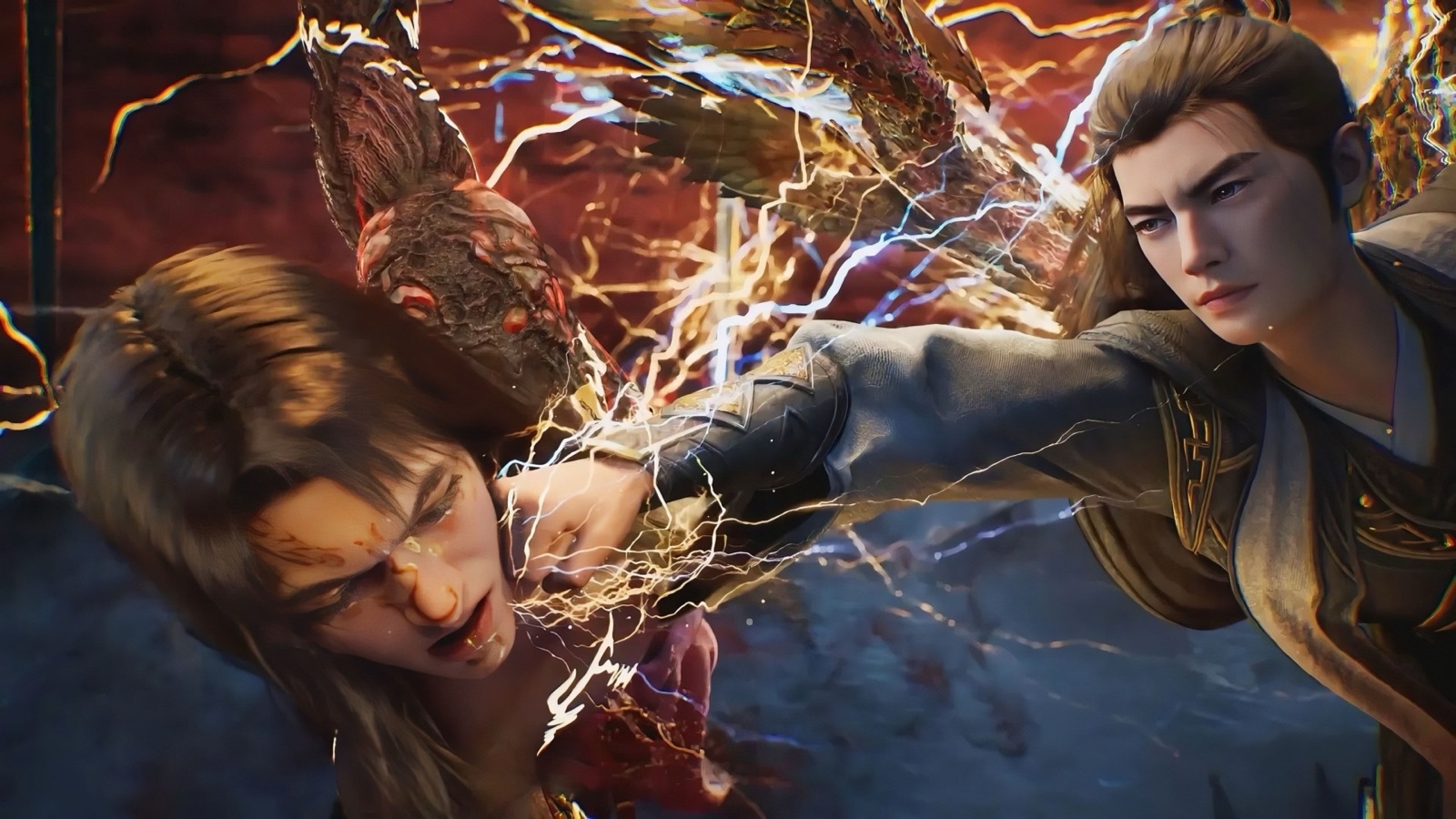
Fire and water: what the battle image actually means
Red-orange fire and blue-white water create an immediately legible visual opposition. Wallpapers often preserve that contrast even when they simplify the surrounding plot.
Good metadata should reconnect the spectacle to the relationship: Ne Zha is not fighting anonymous water magic, and Ao Bing is not confronting a random fire demon. The image depicts two friends acting under incompatible obligations at the point where assigned destiny seems most powerful.

Friendship, rivalry and sacrifice can all be true
Search results often ask whether Ao Bing is Ne Zha's friend or enemy. A binary answer loses the reason the relationship matters. Friendship describes their chosen bond; rivalry describes the conflict of power and role; sacrifice describes what becomes possible when either acts beyond assigned interest.
A knowledge graph can preserve all three relationship types without contradiction. People and stories change across events, and one verb is rarely enough to represent a complete arc.
Why the relationship is not canonically romantic
The films establish intense friendship, mutual recognition and visual symmetry. Fan communities may reinterpret those signals romantically, but that is a separate creative layer rather than the canonical relationship stated by the story.
XianLore excludes heavily romanticized images from the identity core when they materially rewrite the relationship. Such art can only be useful if it is clearly labeled as fan interpretation and remains suitable for a general audience.
What their mirrored destiny says about choice
The Demon Orb and Spirit Pearl begin as a system for predicting moral outcomes. Ne Zha and Ao Bing demonstrate why that system is inadequate: social treatment, family pressure, information and personal decision all matter.
Their relationship gives each character evidence that identity can be recognized outside the assigned role. That is why the friendship continues to matter even after conflict. It is the story's strongest proof that destiny can be resisted, revised and shared.
How XianLore connects the relationship to images
Eight reviewed images are shared between the Ne Zha and Ao Bing archives. They keep one canonical wallpaper URL while storing both character relationships, the visible forms, the fire-water scene and the relevant story article.
Twelve additional images focus primarily on Ao Bing. Generic blue dragon warriors, feminine redesigns, weak distant figures and romanticized rewrites remain noindex so image volume cannot overpower identity accuracy.
Sources used for this guide
The licensed distributor page anchors the first animated film and its international release identity. XianLore uses it separately from the A24 sequel page so the two films are not silently merged.
Ne ZhaWell Go USA Entertainment · Official North American first-film pageA24's official film page establishes the international title and licensed release context. Mythological background and film-specific continuity are kept separate in the article.
Ne Zha 2A24 · Official international film pageAo Bing FAQ
Are Ne Zha and Ao Bing friends?
Yes. They form a genuine friendship before family and clan obligations force them into conflict.
Why do Ne Zha and Ao Bing fight?
Ao Bing is pressured to protect the Dragon Clan through a plan that threatens Chentang Pass, while Ne Zha chooses to defend his family and the city.
Who is stronger, Ne Zha or Ao Bing?
The film frames them as elemental and narrative counterparts rather than supplying one permanent universal ranking. Form, control, circumstance and sacrifice affect the confrontation.
Are the Demon Orb and Spirit Pearl opposites?
They are the two divided spiritual components that assign feared and auspicious destinies in the film continuity, but the characters' choices complicate that simple opposition.
Do Ne Zha and Ao Bing have a romantic relationship?
The animated-film story establishes friendship, rivalry and profound mutual recognition, not a canonical romance. Romanticized fan art should be labeled as reinterpretation.
What does fire versus water symbolize?
Fire and water make their contrast visible, while the deeper mirror is social: both are children asked to carry judgments and conflicts created by adults.

What visual detail from Ne Zha should this guide explain next?